Frequently Asked Questions
What is the BOC’s instrumentation?
The BOC has three microscopes. These microscopes can be roughly arranged on a continuum with high resolution on one end and imaging speed on the other end.
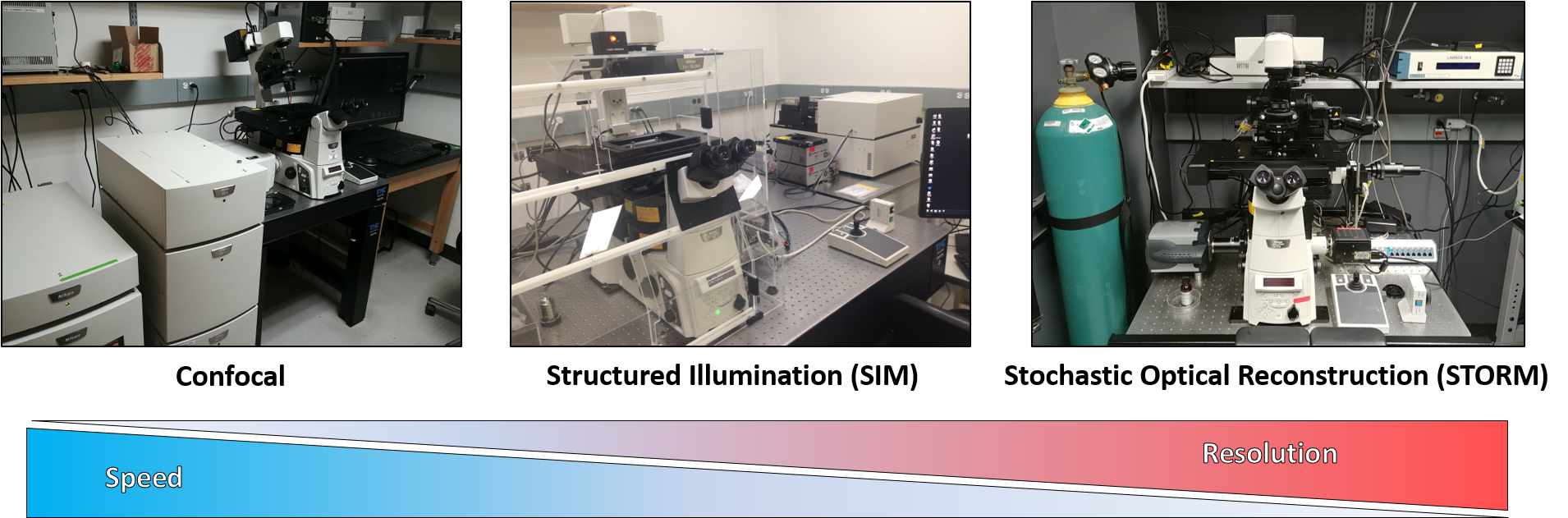
This image is slightly misleading because it reduces the capabilities of each microscope down to only two parameters (speed and resolution), and also doesn’t include the additional imaging modalities present on the STORM instrument. In addition to stochastic optical reconstruction microscopy, the STORM instrument also has TIRF (total internal reflection fluorescence) and widefield modalities. This image should only be used as a starting point. Please contact the BOC manager (opticalcore@biochem.wisc.edu) for specific questions about your imaging experiment or the capabilities of each microscope.
Which microscope is right for me?
This question will be dictated by your sample (live, fixed, etc.), fluorophore selection, desired resolution, and cellular structures you want to image. The confocal microscope is the most versatile microscope with the ability to image a range of fluorophores quickly from 2D or 3D samples. However, the confocal is unable to resolve cellular structures to the level of that stochastic optical reconstruction microscopy (STORM), total internal reflection fluorescence (TIRF), or structured illumination microscopy (SIM) can achieve. On the other hand, the STORM or TIRF methods offer unprecedented resolution but require specific experimental conditions to achieve that resolution. These methods are more time-consuming and only available by using the 100X objective. Similarly, SIM also requires a 100X objective to achieve its high resolution but doesn’t require specific sample preparation. SIM is slower than confocal imaging due to its requirement of capturing either 9 or 15 images (2D versus 3D SIM) to perform an image reconstruction.
Where is the BOC located?
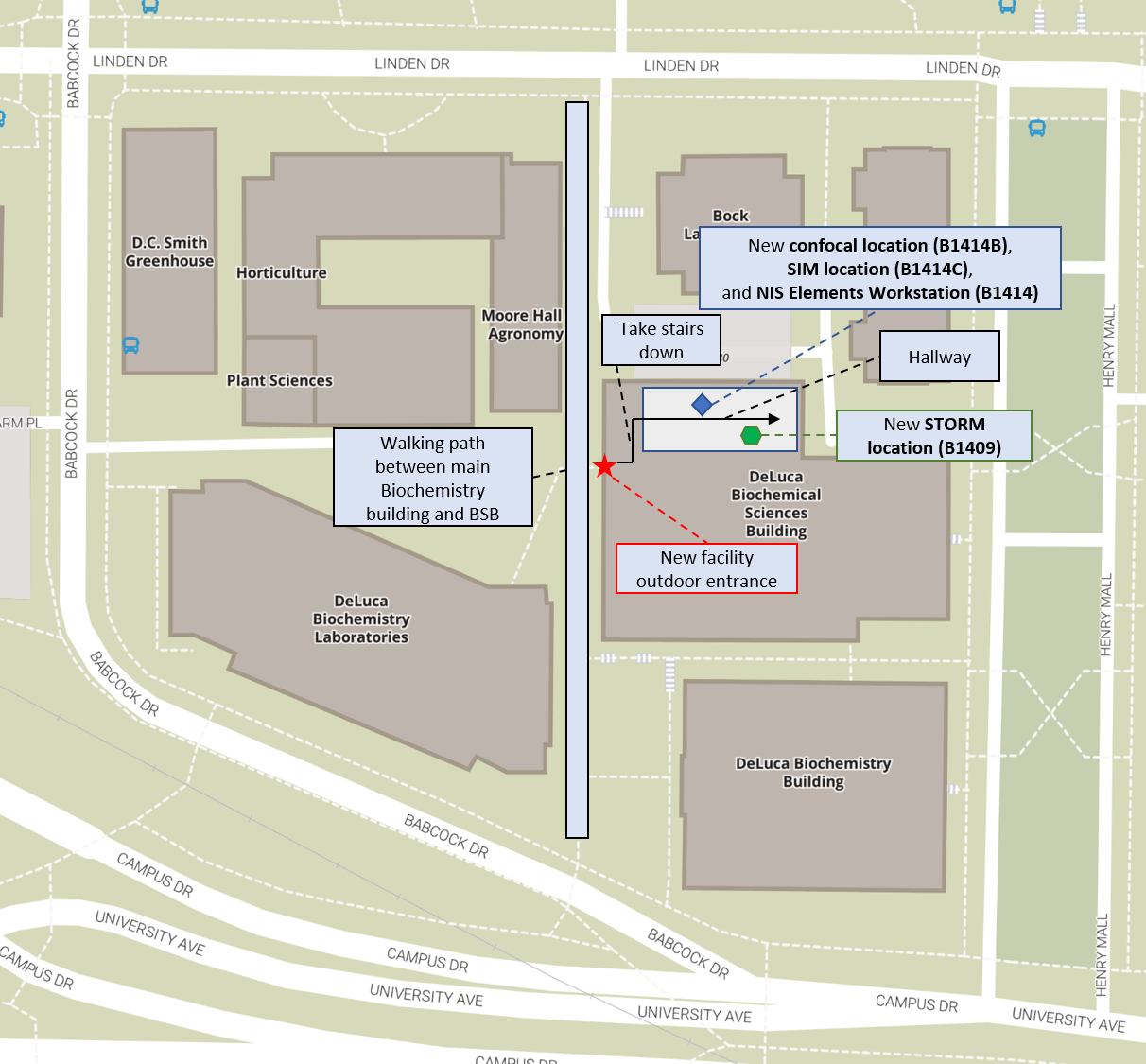
The BOC is located in the recently renovated Biochemistry Core Facilities in the basement of 440 Henry Mall. You can find the BOC by taking the outside entrance along the pathway between the Biochemical Sciences Building and Biochemical Laboratories Building or taking the freight elevator in 440 Henry Mall down to floor “GR”. See below for a map showing the updated locations of all BOC instruments.
How can I get trained on the BOC instruments?
Training is done by scheduling a two-hour block through the BOC’s iLab scheduler (link) anytime Monday – Friday between 9 AM and 5 PM. A funding string must be provided by the principal investigator in order to schedule training. It is recommended that researchers contact the BOC (opticalcore@biochem.wisc.edu) prior to their reservation regarding what samples they’d like to image and the goal of their imaging experiment. In addition to email, the BOC manager can be reached by phone at 608-263-2436 to answer any questions about their imaging experiment.
Once trained, the user will be given “Trained” status through iLab and also given card access to the microscope room. Additional assistance is available M-F, 9 AM – 5 PM, from the BOC manager through email, phone, or brief in-person help.
Can I image on weekends or at night?
What COVID-19 restrictions are in place?
Do I need card access or a key to enter the BOC?
Who makes up the BOC staff?